Why Every Large Company Needs a Chief Simplicity Officer
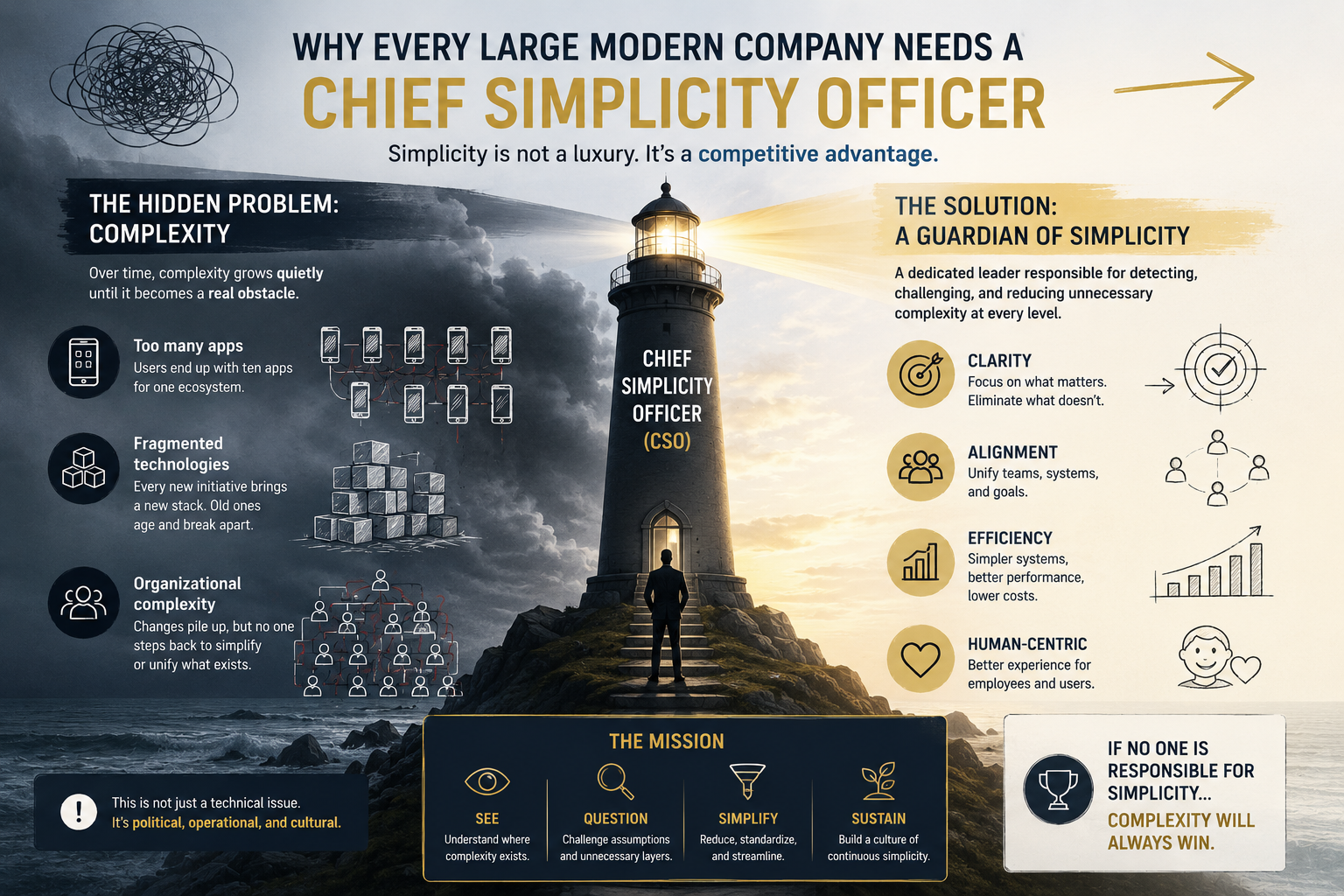
Complexity grows quietly – until it becomes a real obstacle. Why it's time for a dedicated role that champions simplicity as a strategic competitive advantage.
💡 Why every large modern company needs a Chief Simplicity Officer.
In my career, I have worked with large, successful companies that built impressive products and achieved remarkable results. These organizations think smart – they focus on quality, efficiency, people's satisfaction, and profitability.
But there is one critical area that largely remains unaddressed:
👉 Complexity Management.
Over time, I've seen how complexity silently and quietly grows until it becomes a real obstacle – not because people make mistakes, but because no one is officially responsible for keeping it under control.
Three Typical Patterns
Examples I see time and again:
- A company builds a new app for every function – until users need ten apps for a single ecosystem.
- Every new initiative introduces a new architecture or technology, while existing ones age, fragment, and remain unnoticed.
- Organizational changes pile up, but no one takes a step back to simplify or unify existing elements.
This is not just a technical issue. It is political, operational, and cultural.
The Idea: A Guardian of Simplicity
That's why I believe it's time for a dedicated role: someone whose mission it is to identify, question, and reduce unnecessary complexity at every level.
A role like a Chief Simplicity Officer (CSO) or Complexity Reduction Officer – a person who acts as a guardian of clarity and efficiency across systems, teams, and processes.
The Mission in Four Steps
- See – understand where complexity exists.
- Question – challenge assumptions and unnecessary layers.
- Simplify – reduce, standardize, streamline.
- Sustain – build a culture of continuous simplicity.
What Emerges
- Clarity – Focus on the essentials. Eliminate what doesn't work.
- Alignment – Unify teams, systems, and goals.
- Efficiency – simpler systems, better performance, lower costs.
- Human-centric – better experience for employees and users.
If no one is responsible for simplicity, complexity will always win.
Simplicity is not a luxury. It's a competitive advantage.