Backend Development, Spring Boot, and the Reality of Production Cloud Systems
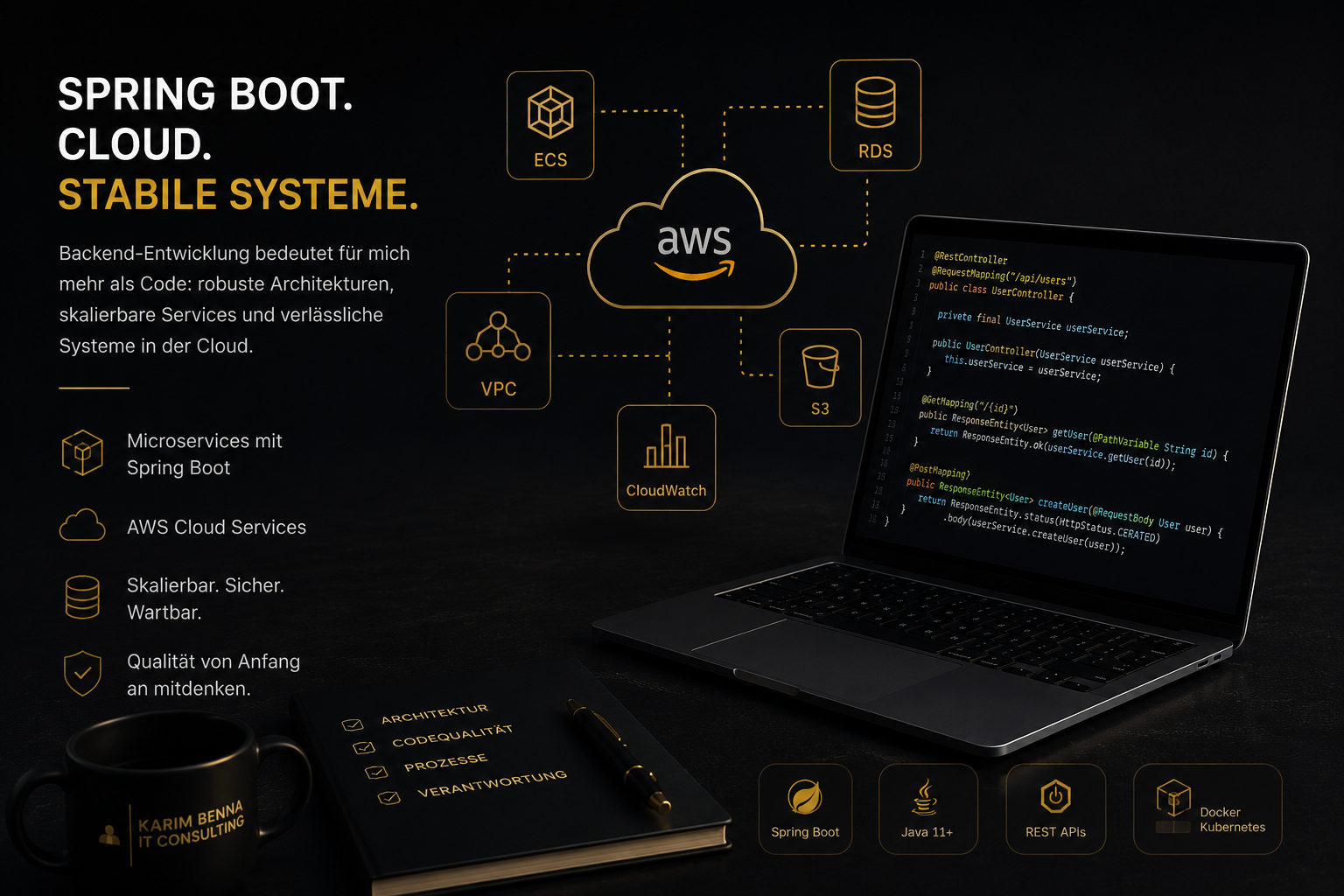
What I've learned from enterprise and automotive projects with Java, Spring Boot, and AWS – why good backends are more than just working APIs, and where configuration details like `spring.jpa.open-in-view` suddenly become critical.
When I started programming, backend development was primarily about logic, APIs, and databases for me. Over the years — especially in enterprise and automotive projects — I've learned that backend systems are actually much more: communication between systems, stability under load, monitoring, quality assurance, deployment processes, security aspects, and often organizational challenges as well.
Java, Spring Boot, AWS – My Entry into Production Backends
My more intensive backend experience began with Java and Spring Boot in cloud environments on AWS. The start was exciting because I had already experienced development, testing, and analysis before. As a result, I've never viewed backend systems as just "code," but always as part of a larger overall system.
In a project at Audi, for example, we maintained a larger number of microservices. The services ran in various AWS environments and were part of complex processes around user and vehicle data. Some services were relatively small, others very extensive and historically grown. That's exactly where you quickly realize that backend development doesn't just consist of writing new features.
A large part of the work consisted of:
- analyzing errors,
- identifying missing requirements,
- stabilizing systems,
- providing hypercare for inherited services,
- making technical debt visible,
- and finding pragmatic solutions without endangering ongoing operations.
Spring Boot: Fast – But Not Harmless
Spring Boot was a very interesting framework for me in this regard. On one hand, it enables rapid development of modern APIs and services. On the other hand, over time you also learn about the risks when systems become larger and more complex.
One example that has stuck with me strongly was a problem around spring.jpa.open-in-view. At first glance, the error seemed relatively harmless. In reality, however, the configuration led to database connections being kept open unnecessarily long until requests were fully completed. In heavily loaded systems, something like this can quickly become critical because connection pools get blocked and stability suffers.
Such situations show that backend development doesn't just mean that a request "works." You need to understand:
- how resources are used,
- how services communicate with each other,
- what impact configurations have on performance and stability,
- and what risks can arise under real load.
Infrastructure Is Part of the Backend
With AWS, I also learned how important infrastructure and deployment processes have become. In the past, people often only looked at "the application." Today, topics like CI/CD, containerization, scaling, monitoring, and cloud resources are automatically part of the reality of modern backend systems.
Technologies like Docker, Kubernetes, or AWS services help enormously with this, but at the same time bring additional complexity. Systems become more flexible, distributed, and scalable — but also more difficult to analyze when problems occur.
That's exactly why I consider documentation, traceability, logs, and monitoring extremely important. Many problems don't arise because developers do poor work, but because systems grow over years, requirements get lost, or knowledge leaves the company.
What Backend Development Means to Me Today
What still excites me about backend development today is exactly this mix:
- technical depth,
- analytical thinking,
- architecture,
- troubleshooting,
- communication between teams,
- and the challenge of keeping complex systems stable and maintainable in the long term.
For me, good backend development isn't simply writing APIs. It means building and evolving systems that remain comprehensible, stable, and maintainable even under real conditions.
And that's exactly where, from my perspective, the real difference begins between "writing code" and genuine software development.