QA-Enforcer – Quality Assurance as a Connecting Element in Complex Systems
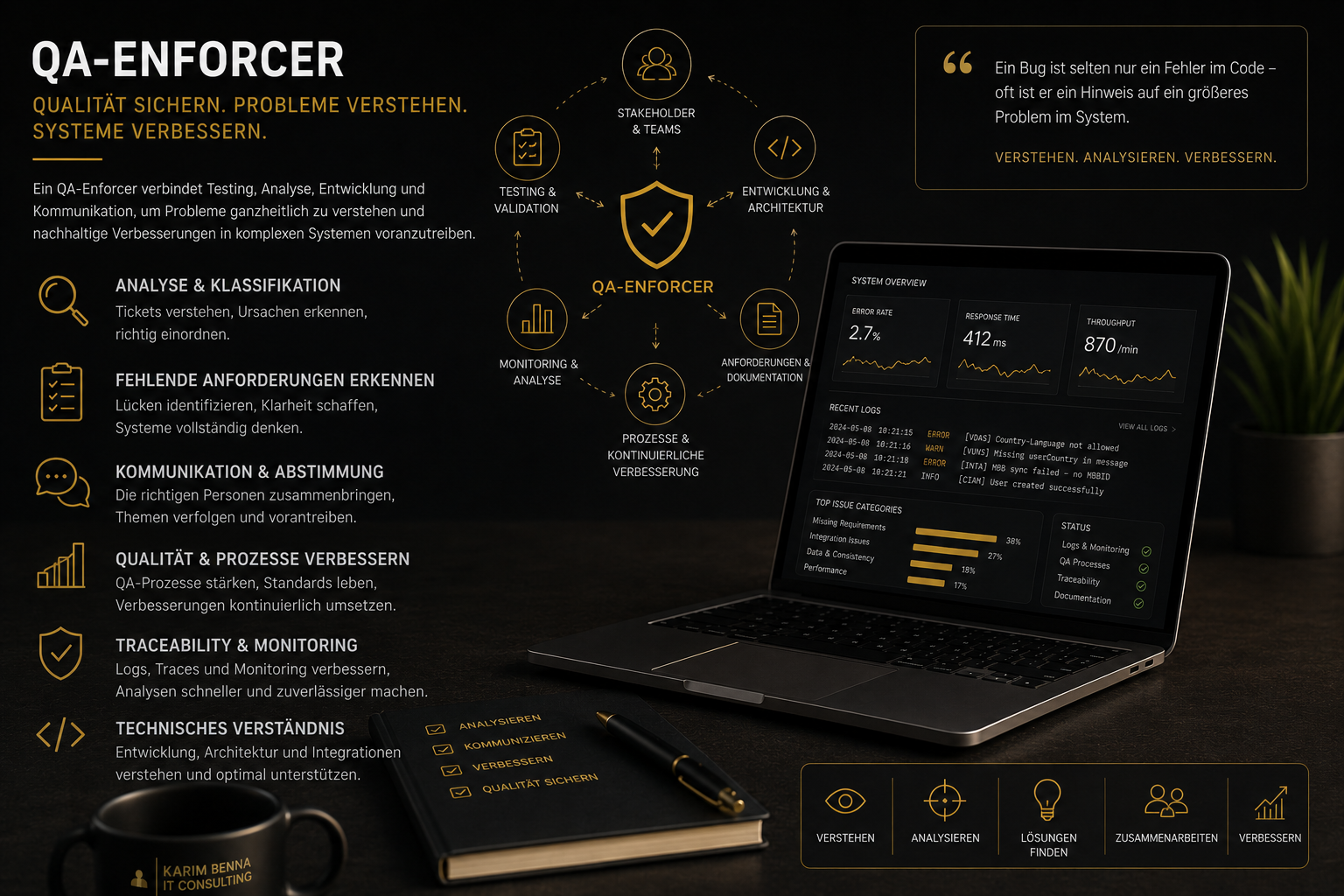
Why a bug is rarely just an error in the code – and how the role of the "QA-Enforcer" connects testing, development, architecture, monitoring, and communication in enterprise systems.
The idea of a "QA-Enforcer" emerged from the observation that quality assurance in complex system landscapes is often distributed across multiple teams, processes, and responsibilities. Especially in existing enterprise systems that are already in production and have grown over a longer period, a large volume of bugs, support cases, and organizational challenges arise.
Throughout various projects, it became increasingly clear to me: A bug is not always just an error in the code.
A bug can also be:
- a missing requirement,
- an unclear architectural decision,
- a communication gap,
- a missing system integration,
- a monitoring problem,
- or a process that no longer fits the reality of the system over time.
Especially in large, distributed systems, an error is often just a symptom of a larger problem. That's why it's frequently not enough to simply "work through" tickets. You need to understand how the systems are interconnected and what organizational or technical causes lie behind a problem.
Why the Role Emerged
In enterprise projects — especially after taking over existing services or with heavily grown architectures — a situation often arises where:
- knowledge is distributed or has been lost,
- requirements were not fully documented,
- teams only look at their own services,
- and error analysis takes a lot of time.
At the same time, it became evident that many quality problems cannot be solved through classic Scrum feature development alone. Continuous improvement requires time, technical curiosity, and the willingness to think beyond one's own direct responsibility.
I therefore understand the role of the QA-Enforcer not as a classic testing role, but rather as a technical and organizational interface between:
- development,
- quality assurance,
- analysis,
- support,
- architecture,
- monitoring,
- and communication.
Tasks of a QA-Enforcer
The tasks range from technical analysis to process improvement, depending on the project and system landscape. These include:
- Analysis and classification of incoming bug tickets
- Identifying missing or unclear requirements
- Quick technical initial assessment of problems
- Solution proposals for recurring pain points
- Improvement of logs, monitoring, and traceability
- Support for QA and support processes
- Analysis of resource and system behavior
- Communication between teams and stakeholders
- Promoting long-term improvements instead of short-term workarounds
What's particularly important is the ability to pragmatically assess problems: Is it really a defect? Or rather a missing requirement, incorrect integration, or an architectural issue?
Missing Requirements as Real Causes of Problems
In several projects, it was observed that certain requirements in the overall system were never properly defined or were lost over the years. Reasons for this can be personnel changes, lack of communication, or historically grown assumptions.
A concrete example was a service that consumed various messages from another system and forwarded them to other backend services. During the analysis, it became apparent that certain methods existed but were never used. After deeper investigation, it became clear that originally more message types should have been processed, but this functionality was never fully implemented.
Such situations show that bugs can sometimes provide valuable hints about larger structural issues.
Communication and Perseverance
Many technical problems cannot be solved in isolation within a single team. Especially in large system landscapes, multiple stakeholders, business departments, and external systems often need to be considered. That's why communication and perseverance are important components of this role.
A recurring pattern in enterprise projects is that known problems remain unsolved for a long time, even though the actual technical solution would be comparatively small. Often the difficulty lies not in the coding itself, but in:
- coordination,
- responsibilities,
- prioritization,
- or missing decisions.
The QA-Enforcer tries here to make issues visible, bring the right contacts together, and drive improvements forward in the long term.
Traceability, Logs, and Monitoring
One of the most important foundations for fast error analysis is good traceability.
Logs, traces, and monitoring are crucial for being able to understand complex error patterns. However, in many systems, important information or connections between frontend, APIs, messaging systems, and backend services are missing.
That's why continuous improvement often also includes:
- better logs,
- more meaningful trace IDs,
- monitoring extensions,
- more structured error messages,
- or clearer documentation.
Small improvements in these areas can save a lot of analysis time in the long run.
Quality Is Not an Isolated Role
The term "QA-Enforcer" is not meant to imply that quality depends solely on a single person. Good quality always emerges through collaboration.
The idea behind this role is rather: to bring in a technical and organizational perspective that goes beyond individual tickets or features and continuously tries to make systems more understandable, stable, and maintainable.
For me, quality assurance is therefore not just testing.
It is a continuous improvement process that connects development, analysis, communication, monitoring, and architecture.